For most tourists, the New York subway is a chaotic labyrinth. It is, however, the fastest and cheapest way to get around the city. With its 472 stations (!), you can reach any part of the city, so long as you understand its system.
Getting around is simple once you understand the system. As of January 2026, MetroCards have been discontinued; you now pay by tapping any contactless credit/debit card, smartphone (Apple Pay/Google Pay), or a dedicated OMNY card at the turnstile. The fare is $3.00 per ride. After 12 rides within 7 days, all additional rides are free, capped at $35/week. No card to buy, no registration needed.
In the article below, you will find all the relevant information that will help you to comprehend the New York subway system and how you can save money.
Becoming familiar with Maps
Understanding the maps is the first step toward navigating the subway more easily. After you decide which part of the city you want to visit, the maps will help you choose the right lines.
In the western part of New York are lines 1, 2, and 3, and lines E, C, B, and D. On the east side are lines 4, 5, and 6. All lines are separate and end in different places. You must follow the lines on the map to get to your destination.
It will be much easier to use the subway if you have a map or download it on your mobile. A recommended app that also works offline is the New York Subway Official MTA map of NYC. There is also a map at every station, and if you can’t find it, the station staff is very helpful.
Use numbers and letters, not colors.
Looking at the map, you will see that the lines are in different colors. They also have letters and numbers. The locals don’t use the lines by color but by letters or numbers. The colors show that certain lines pass through the same tracks at certain points.
You must always choose the line by its number or letter, not its color. Even if lines have the same color at some points, they end up in totally different locations. Lines A, C, and E are all blue, but they separate at Canal Street.

Arriving by plane? Check our guide on getting from the NYC airports to Manhattan
Local or express trains/black or white dots?
You will also notice that some stations on the maps are dotted in black, while others are in white. Local trains stop at all stations, whether they have black or white dots. On the contrary, express trains stop only at the white dotted stations, never at the black ones.

In the image above, you can see subway station 86 St (blue circle) with the line no. 1 indication beneath it and a black dot. This means that the line 1 train is local and the only one that stops at this station. On the other hand, at station 96St (black circle), the dot is white and indicates lines 1, 2, and 3. This means that the trains of lines 2 and 3 are express and stop only at this station.
This is one of the most common mistakes that tourists make on the NY subway. Unknowingly, they board an express train and end up at a station much farther from their destination. Let us say that you want to go to the Natural History Museum on 81st Street. As you can see in the image below, lines B and C lead to the 81st Street station. Since this station has a black dot, it’s a local station, and lines B and C are local.

Notice that at station 125 St (red circle), which is served by lines B and C, as well as lines A and D, the station’s dot is white, indicating that lines A and D are express. So they do not stop at 81 St or at any other station with a black dot.
If you are at the Columbus Circle/59 St station and are headed north towards 81 St, you must take the B and C trains. If you take trains A and D, the next stop will be 125 St, a mistake that will cost you a lot of time.
Uptown or Downtown?
It is also very important to understand whether you are going Uptown or Downtown. In other words, north or south, to choose the right platform.
Many stations, usually the local ones, have separate entrances for Uptown (left image) and Downtown (right image). That means you might have to walk to the opposite sidewalk and go down to the platform, which will take you in the right direction.


At some stations, instead of Uptown, you might see the sign BronxBound or QueensBound, and instead of Downtown, the sign might say Brooklyn or Lower Manhattan. This indicates the train’s last stop and direction.
Choosing the right station
The station’s name will usually help you locate where you are on the map and choose where you want to go. However, many stations have multiple entrances; for example, Canal St has 5 exits.

Use the underground docks to transport to the stations
Another mistake first-timers make in New York is exiting one station to enter another to take a different line, only to end up paying for a second ticket. Some stations have pedestrian tunnels that unite different stations. And even have shops and restaurants, and many buskers who fill the tunnels with music.
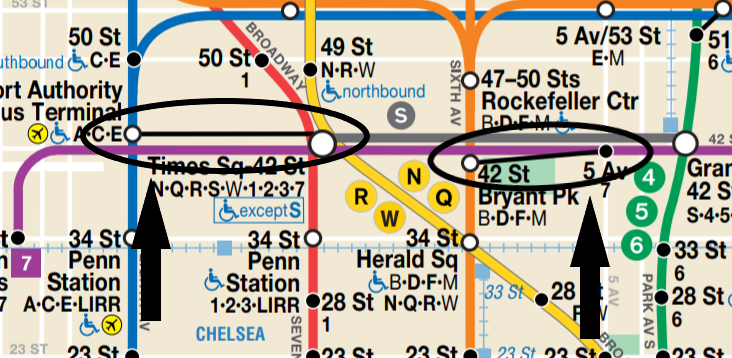
Thus, if you find yourself at Port Authority Terminal and want to take line 7, you don’t need to exit the station and walk east towards the station Times Square. Instead, you can walk through the tunnel, following the signs to your line, without needing to exit the station or buy a new ticket.
Red and Green spheres
You might notice red or green spheres upon entering a station, like the ones in the image.

These spheres indicate to passengers which stations are open 24 hours and which are closed at night. The green spheres also indicate that these stations only have stairs. Recently, the red spheres have been diminishing to the degree that you might not see them at all in the future.
How to Pay with OMNY
Since January 2026, all subway fares in New York have been paid via OMNY, the contactless payment system that replaced MetroCards. Here’s what you need to know:
- Simply tap your contactless credit or debit card at any turnstile, and you’re charged $3.00 automatically
- Works with Apple Pay, Google Pay, and any NFC-enabled device
- If you prefer a dedicated card, pick up an OMNY card at any station vending machine for $1
- Free transfers: use the same card for subway to bus transfers within 2 hours at no extra charge
- Weekly fare cap: after 12 rides in 7 days, all additional rides are free (max $35/week)
- Always use the same card or device every time to benefit from free transfers and the fare cap
For a complete guide to OMNY fares and tips, read our OMNY guide here.
Ask for Help
If you are not sure you are taking the right train or standing on the right platform, do not hesitate to ask.
Local New Yorkers are famous for being antisocial and snobs, but you will be surprised at how helpful they are with directions. If they see you looking lost, they might even approach you themselves without you asking.
The staff at every station is also very helpful, and so are the police who guard every station.
Empty wagons
If, during rush hour, you see an empty wagon with all the passengers squeezed onto one side, there is a reason for this. If you don’t have a good sense of smell or don’t want to catch a virus, you had better change wagons. A tragic reality of New York is its homeless, its poor, and its mentally ill, who, especially during the cold months, find refuge in the subway wagons.
Planning what to do in New York? Browse the best New York City tours and experiences, from Broadway shows to Statue of Liberty tours, with skip-the-line options available.
Beware of your things
Our last advice for the New York subway is stating the obvious. Watch out for your personal belongings, your wallet, your mobile, passports and IDs, and the rest of your possessions.
The NY subway is safe, with police stationed at every station. This doesn’t mean that there aren’t malicious pickpockets around.
Planning your New York trip? Read our complete New York travel guide for neighborhoods, attractions, and insider tips.
Frequently Asked Questions
The standard fare is $3.00 per ride as of January 2026. After paying for 12 rides in any 7 days, all additional rides are free, with a maximum weekly cost of $35. Reduced fare for seniors and people with disabilities is $1.50.
MetroCards were discontinued in January 2026. You now pay by tapping any contactless credit or debit card, smartphone with Apple Pay or Google Pay, or a dedicated OMNY card at the turnstile. No registration or setup required.
Local trains stop at every station marked with black dots on the map. Express trains only stop at major stations marked with white dots. Always check the dot color before boarding to avoid overshooting your stop.
Uptown means heading north (towards the Bronx), downtown means heading south (towards Lower Manhattan and Brooklyn). Many stations have separate entrances for each direction. Check the signs carefully before going through the turnstile.
The subway operates 24 hours a day, and police are present at every station. As with any major city transit system, keep an eye on your belongings, especially during rush hour. If a subway car appears unusually empty during busy times, there is usually a reason to move to the next car.
Green spheres indicate the entrance is open 24 hours. Red spheres indicate limited hours; the entrance may be closed at night. Green sphere entrances also typically have stairs only, while some red sphere entrances may have elevator access.
Yes, as long as you use the same card or device for each tap, transfers between subway lines within the same journey are free. Transfers between subway and bus are also free within 2 hours when using the same card.