Warsaw! The beauty of Europe that has been through so much. Colourful and picturesque neighbourhoods, beautiful squares, palaces, and open-air markets are among the things that make up the capital’s pattern and give the city a pulse.
It is important to know that both the old and new cities were bombed by the Nazis in World War II. They were rebuilt after the war with such detail that the buildings appear to be the same age as the originals, rather than having a lifespan of only a few decades. Below is our article, we list everything you need to know before your first visit to Warsaw.
| Country | Poland (EU & Schengen member) |
| Population | ~1.8 million (city) |
| Language | Polish |
| Currency | Polish Złoty (PLN) |
| Entry (EU/Greeks) | ✅ ID card sufficient |
| Entry (US/Canada/Australia) | ✅ No visa — 90 days Schengen |
| Palace of Culture — observation deck | ~€12 — 30th floor, 114m |
| Warsaw Uprising Museum | ~€8 / Free Thursdays / Closed Tuesdays |
| POLIN Museum | ~€11) / Free Thursdays / Closed Tuesdays |
| Royal Castle | ~€9) / Free Sundays |
| Chopin Concerts Łazienki | FREE — every Sunday May–Sep, 12:00 & 16:00 |
| Auschwitz day trip | ~2h by bus (~€1.50) — reserve at auschwitz.org |
| Metro single ticket | ~€0.95 |
| Hostel dorm | ~€18–30/night |
| Mid-range hotel | ~€60–110/night |
| Best time | May–Jun & Sep |
| Flights | 👉 Skyscanner |
| Accommodation | 👉 Booking.com — Warsaw |
| Tours & activities | 👉 GetYourGuide — Warsaw |
| Car rental | 👉 Discovercars.com |
| eSIM Poland | 👉 Airalo |
Transportation
Transfer from/to the airport
There are two airports, Modlin and Chopin. Specifically, Modlin is located approximately 40 km north of the centre of Warsaw, while Chopin is only 11 km away. Below we will list all the indicative modes of transport from the airports to Warsaw city.
Taxi: From Modlin Airport, the average journey time to/from Warsaw, in favourable driving conditions, is approximately 40 minutes. The price list for these routes is predetermined and depends on your destination in the city. From Chopin Airport, the travel time to the city centre is about 30 minutes.
For reservations and prices, check on Welcome Pickups
Train: An economical way to get to Warsaw from Modlin Airport is the Koleje Mazowieckie train. You will first need to take the corresponding bus, whose stop is located just outside the airport. The bus will take you to the train station in Modlin, where you will make the transfer and continue to the centre of Warsaw. Buses run every 20-30 minutes, while the train ride takes between 40 and 60 minutes (depending on the station you get off at). The time required to travel by bus from/to the train station is approximately 10 minutes.
At Chopin Airport, there are two companies, SKM and KM. The journey takes 20 to 25 minutes for both lines. SKM has 2 lines, S2 and S3, that will take you to the city centre. With S2, you can go to Warszawa Śródmieście station, while with S3, you will stop at Warszawa Centralna, where you can connect to the regional and intercity train at the railway station. On the other hand, the KM railway line will take you to both destinations.
Bus: The ModlinBus connects the Modlin Airport terminal with the centre of Warsaw and is one of the cheapest and simplest modes of transport. Tickets can be purchased online, at the airport and inside the bus. The route to the city centre takes about 40-50 minutes. Their big advantage is that the timetables are adjusted to the departure and arrival times of the flights from Modlin airport. From Chopin Airport the best way to get to the centre of the Old Town is to take bus 175. The bus stop is located just outside the arrivals hall, after leaving the security checkpoint and the journey takes about half an hour.
Travel within the city
Metro: The Warsaw Metro started operating in the Polish capital in April 1995. There are two metro lines in Warsaw. Metro line M1 operates from 05:00 am – 00:10 am from Monday to Thursday and on Sundays. On Fridays and Saturdays, the operating hours are 05:00 am – 03:00 am. M2 has almost similar opening hours, 05:00 am – 00:40 am and 05:00 am – 03:00 am. The M1 line runs from north to south, while the M2 line runs from east to west. Both lines intersect at Swietokrzyska station, which is near the Palace of Culture.
The metro provides easy access to the Vistula River, the two main pedestrian streets, Krakowskie Przedmiescie Street and Nowy Swiat Street, as well as the National Stadium on the other side of the Vistula River in the Praga district. Many hotels are also located near the Centrum metro station.
In the event of an unforeseen service interruption (e.g., breakdown or planned works), metro service may be suspended, and alternative means of public transport marked with the letter ‘Z’ may be provided.
Bus: By bus, you can go everywhere in Warsaw. The network of bus lines extends throughout the city. Regular routes run from around 5:00 am to 11:00 pm. After this time, night buses take over. It is a fairly economical and fast way to get around Warsaw and, at the same time, see the views and highlights of the city.
Timetables and prices can be found on Omio.com
Taxi: Warsaw taxis are quite cheap. Drivers use taximeters to determine the final fare for your journey, which depends on traffic, distance, and time of day. The fares are official, as they are set by the government and must be adhered to by all companies. You can find them anywhere, and there are also many taxi stands around the city. Just raise your hand to stop a passing driver and make sure the taxi is legal before you board.
Officially and legally registered taxis have their numbers printed on the front doors of the vehicle, on the roof sign, and on the inside of the driver’s taxi license. They also have price information on the rear side window. Avoid taking unofficial taxis in Warsaw, as they are very likely to overcharge you. Finally, always make sure the meter is on and don’t accept fixed prices unless you know they are reasonable.
Trams: trams can be numbered from 1 to 79. The numbering from 1 to 39 covers the main connections. Lines 40 to 49 operate at certain times of the day or week (e.g., during peak traffic hours). Trams with other numbers operate on special or alternative lines.
In the event of an unforeseen service disruption (breakdown or planned works), as mentioned above for the metro, tram services may be interrupted and alternative means of transport marked with the letter ‘Z’ or ‘Z’ together with a number, e.g., ‘Z-4’, may be provided.
Bicycle: Warsaw is a cyclist-friendly city, which can be seen in the continued development of cycle paths. There are several places within the city where you can rent a bike to explore any place you want on your way. The most well-known rental app is Veturilo, through which you can pick up your bike from a point within the city, and when you are done riding, you can leave it elsewhere without having to return it to its original location. The main thing?! The first 20 minutes are free! The maximum time is 12 hours. If the bike has not been returned by then, there are the corresponding penalties listed on the company’s official site. The bike is one of the most economical options for getting around Warsaw, while at the same time, you shape your schedule exactly as you want.
Where to Stay in Warsaw
Warsaw is significantly more affordable than Western European capitals:
- Hostel dorm: ~€18–30/night
- Budget hotel: ~€40–70/night
- Mid-range hotel: ~€60–110/night
- Luxury: ~€120–250+/night
Best areas:
- City Center / Śródmieście: Close to Palace of Culture, metro, Nowy Świat boulevard
- Old Town / Stare Miasto: Maximum atmosphere, walkable to main sights
- Praga (east bank): Trendy, authentic, 10–20% cheaper — but across the river
Browse Warsaw accommodation on Booking.com
What to do in Warsaw
Old Town (Stare Miasto)
Warsaw’s Old Town is the jewel in the crown of the Polish capital, and not for nothing. It delights visitors with its colourful buildings and the unique atmosphere of its picturesque streets. It has been included in the UNESCO World Heritage List!
Be sure to visit the Royal Castle. This is where the Constitution of 3 May was passed, the first in Europe and the second in the world. In the former home of the Polish rulers, you will see the royal apartments, Rembrandt’s paintings, and canvases by Bernardo Bellotto. In Castle Square is the statue of King Sigismund III Vasa, who in the 16th century moved the capital of Poland from Krakow to Warsaw. The oldest and highest monument in the capital is an excellent landmark where locals in Warsaw often arrange to meet.
The Old Town Square is the oldest and one of the most charming squares in Warsaw. In the middle of the square stands the statue of the Warsaw Mermaid, the emblem and guardian of the city.
If you have time to walk and explore, you can visit the Warsaw Museum, take a stroll along the old city walls, and photograph the Vistula from the observation point in Gnojna Góra. Enter the cathedral, which houses the tombs of the medieval princes of Mazovia, the last king of Poland, Stanisław August Poniatowski, and the outstanding pianist and politician Ignacy Jan Paderewski. In summer, the Old Town is full of life, and various cultural festivals and events take place.

The Royal Road (Trakt Krolewski)
It connects three former residences of Polish rulers: the Royal Castle, the Royal Baths, and the Wilanów Palace. It is the most famous route in the city. Among the buildings surrounding Krakowskie Przedmieście and Nowy Świat streets are the Presidential Palace, the Warsaw University campus, as well as beautiful churches and mansions. The route continues along the elegant and leafy Aleje Ujazdowskie, with embassies and ministries located along the way. This historic route ends at the Wilanów Palace. The route is particularly spectacular in winter when it is illuminated with thousands of lights as part of the Great Illumination.

Praga District
Located on the right bank of the Vistula River, it is considered to be the most genuine and authentic part of the city. During the Second World War, it did not suffer as much as the city centre, so you can still admire its original architecture. Its charming alleys, bustling restaurants, modern art galleries, and excellent combination of historic industrial architecture and modern design concepts have made Praga a favourite spot for Warsaw artists.
Lazienki Park
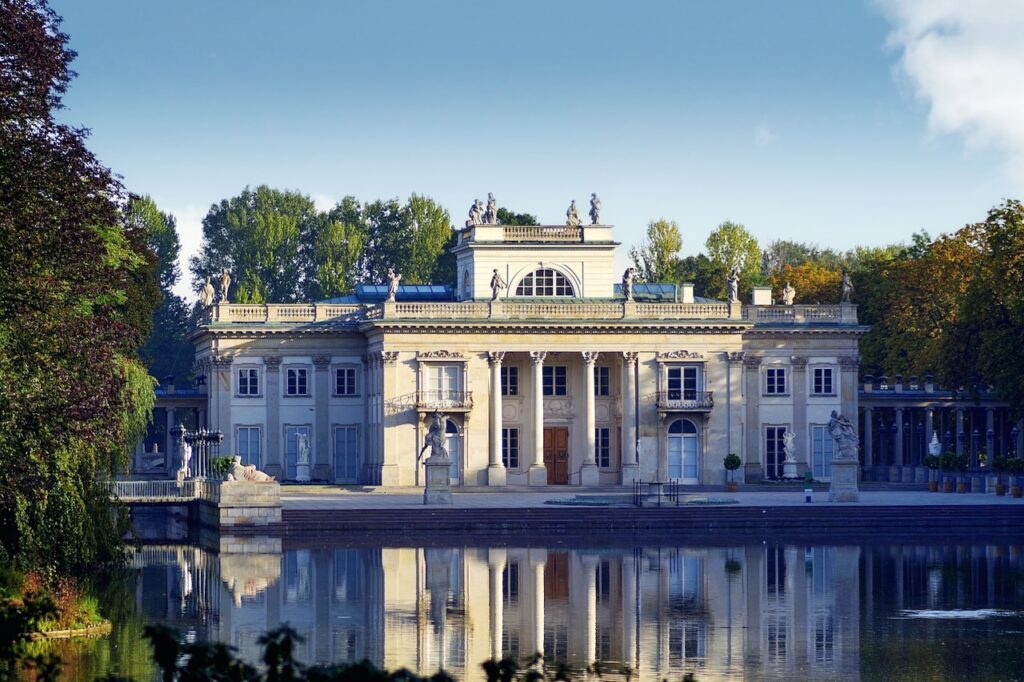
This huge garden is a favourite place for locals, where they take long walks through the beautiful nature to take a break from the hustle and bustle of the city. In the heart of the park is the summer residence of the last king of Poland, Stanisław August Poniatowski. The name of the complex comes from the bath of a 17th-century Polish nobleman, which was reconstructed in the 18th century into a palace. There, the king hosted his famous Thursday dinners, to which he invited scholars and poets to discuss the topics of the day. Today it is a museum where you can admire paintings from the royal collections.
On the grounds of Łazienki, you will also see an amphitheatre, the Museum of Hunting and Riding, the Myślewicki Palace, and many free sculptures.
From spring to late autumn, the gardens are full of blooming flowers, and you may encounter squirrels, ducks, and swans. If you visit Warsaw in the summer, be sure to take part in one of the famous Chopin concerts, which take place every Sunday at 12.00 and 16.00 from 15 May to 25 September. In winter, take a stroll along Chinese Avenue, where you’ll see several metres-long luminous figures in period costumes.
National Museum of Warsaw
The museum houses a magnificent collection of more than 830,000 exhibits from all periods, from antiquity to the present day. Masterpieces of Polish and world art are presented in thematic galleries.
In the Gallery of Old Art, you will be transported to a time when painting and sculpture were on an equal footing with craftsmanship. Next to the paintings and sculptures, you’ll see beautifully decorated furniture, textiles, and dishes, and even the coat and coronation insignia of King Augustus III. Similarly, in the 19th-century Gallery, you can see a masterpiece, which is the Battle of Grunwald. It is the largest Polish painting, and its canvas covers almost 40m2.
Finally, you can see original 15th-century altars from different regions of Poland, Gothic sculptures and paintings for private prayer houses.
Palacu Wilanow Palace
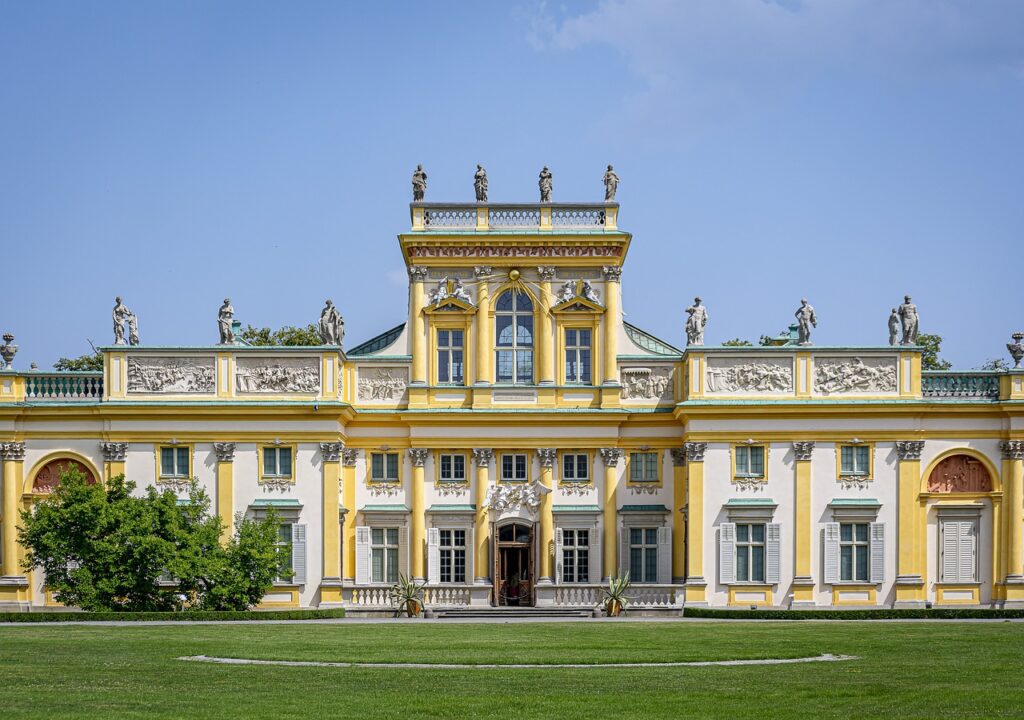
The palace escaped the fate of the city of Warsaw and survived the war almost intact, although its collections were severely looted. It was meticulously renovated during the 1950s and early 1960s, reopening its doors to the public in 1962.
The Palace and Gardens of Wilanów are located about 10 km south of the city centre and can be reached by bus or taxi. The city’s metro system leads to a stop called “Wilanowska”, but this is about 5km from the palace, and you will need to take a bus outside the station. All buses stop just outside the palace gates at the “Wilanów” stop.
Every year, from early October to late February, the gardens around Wilanów Palace are transformed into a colourful and festive ‘land of lights’ as literally thousands of tiny LED lights outline the baroque outline of the sculptures, gardens, and plants. There is also a natural lake located behind Wilanów Palace, where you can hire gondolas for leisurely rides on it from May to the end of August.
Tickets and prices can be found on GetYourGuide
Vistula River
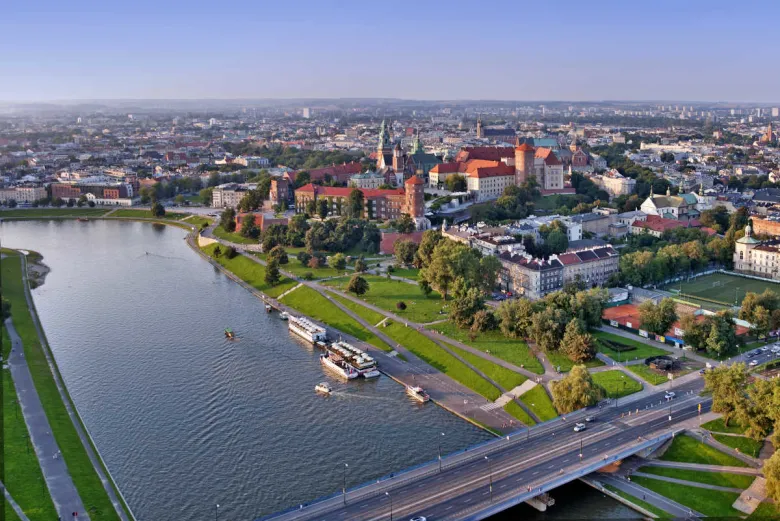
No other river in Europe is like the Vistula River that flows through Warsaw. Its natural banks, inhabited by wild birds, are located right next to the city’s boulevards. On summer weekends, the heart of the city beats there. Trendy bars and clubs, charming bistros, and open-air events attract both city residents and tourists, while the sandy beaches are the perfect place to relax. An interesting option is a river cruise to see the city’s views from the water.
Your walk can be carried out in peace for families with children as well as for people with disabilities, since they have made sure that the appropriate infrastructure is in place. You can stop to rest at one of the stone sculptures in the form of fish and other water creatures.
The Palace of Culture and Science
One of the highest and most famous buildings in Warsaw. It is visible from almost every point of the capital. It was inaugurated in 1955 on Stalin’s initiative as a “gift of the Soviet people to the Poles”. Built by Russian workers, for a long time it was considered a symbol of socialist power and the pride of the People’s Poland. From the beginning of its operation, its monumental interiors hosted numerous concerts, exhibitions, festivals, and shows.
Today, the palace is home to theatres, cinemas, museums, modern pubs, and Warsaw’s central tourist information office. You can climb to the observation deck on the 30th floor of the building and see the beautiful panorama of the city from a height of 114 metres. On the upper floor, you can even find and buy various related souvenirs.
You can even see the realistic sculptures placed in the niches of the palace facade. Each one symbolizes a different field of science, art, technology, or culture, for example, a young man with a book of classical literature, a member of the communist movement, an archer, and a woman from Central Asia. In a straight line from the main entrance, you will find a stone honorary platform from which the first secretaries of the Central Committee of the Polish Communist Party greeted those who marched in the May Day parade.
In summer, the area around the palace hosts numerous concerts, theatre performances, and film screenings. In winter, it is a great place for skating enthusiasts thanks to the free ice rink. At night, the building is beautifully lit, and additional decorations illuminate special occasions.

New Town (Nowe Miasto)
The new town, Nowe Miasto, formerly known as New Warsaw, was an independent city until the 17th century. The New and Old Towns are separated by the Barbican, the old medieval wall that surrounds the city. After crossing it, you can walk along Freta Street to Rynek Nowego Miasta, the New Town Square, where you can see the statue of Marie Curie. This area is widely known as the city of churches because it is full of them. The most famous ones are the Church of the Holy Spirit, the Church of the Cross, and Saint Jacek’s Church.
Srodmiescie
The absolute centre of the city, where most of the modern skyscrapers are located, is sometimes called Centrum. Modern buildings housing international companies, 5-star hotels, and glitzy shopping malls stand next to worn-out grey skyscrapers built under the Soviet communist regime. There are a few long and busy avenues in the area, and Marszalkowska is perhaps the busiest of them. In the area, there is also one of the oldest public parks in the city, Ogród Saski (Saxon Garden), which was built in the year 1772 and was the first park in the world to open its doors for recreational purposes.

Copernicus Science Centre
A real paradise for science lovers. You can discover the secrets of nature, do experiments yourself, and have fun. You will discover how much your body can do, its sensitivity to light, perception of colours, and various other illusions. Hundreds of exhibits will help you understand the phenomena associated with waves and currents.
In the exhibition “The future is today – Digital brain?” you will see various innovations, whether you can trust machines, love a robot, how it “thinks”, and other information about artificial intelligence. The humanoids you will see are able not only to speak and gesture but also to express emotions.
In the high-voltage exhibits, you will watch an unusual show starring electrical discharges, and you can try to be electrified safely by up to 20,000 volts. If you like challenges, visit the Thinkatorium. Equipped with the necessary materials, you can build a bridge or a flying vehicle. Finally, there is a Planetarium where you can watch various themed shows.
Warsaw Uprising Museum — One of Europe’s Best WWII Museums
If you visit only one museum in Warsaw, make it this one. The Warsaw Uprising Museum tells the story of the 63-day uprising of 1944, when Polish resistance fighters, hoping to liberate Warsaw before Soviet forces arrived, fought the German occupiers with homemade weapons and extraordinary courage. The Nazis crushed the uprising, then systematically dynamited 85% of Warsaw as collective punishment. Over 200,000 civilians died.
The museum is immersive, deeply moving, and brilliantly designed. It feels like bearing witness. One of the most important and powerful museum experiences in all of Europe.
Read our full travel guide to Poland
Best places to eat in Warsaw
Koszyki Hall
The gastronomic centre of Warsaw. Koszyki Market was built at the beginning of the 20th century, but since 2016, it has been reborn with a new gastronomic concept. You will find many pubs and restaurants of all kinds that will allow you to choose the cuisine you like the most and enjoy it at the tables located in the centre of the market.
Dock 19
For dining on the banks of the Vistula. A place with warm industrial decor, but also a pleasant terrace. With various food options, well-roasted meat, and friendly service. The restaurant is also famous for its cocktails.
Ale Wino
You have to look a little harder for this address, but it’s more than worth it. The place has a great atmosphere. The dishes are exquisitely decorated, the flavours are special, paired with excellent wines of great variety, and all of the above, accompanied by friendly service. The prices are a bit higher compared to other places, but it’s worth it. It is advisable to make a reservation before visiting.
Soul Kitchen
In the heart of the city, Soul Kitchen reintroduces you to more modern touches, typical Polish dishes such as pierogis (ravioli) or soups, as well as other dishes such as risotto, duck, etc. Some dishes are cooked and/or prepared in front of you, so you can admire the talent of the cooks in the restaurant. Because the dishes are gourmet, the cost is a bit higher, but the prices are fully commensurate with what you eat, both in quality and quantity!
When to go
The best time to visit Warsaw is from late May to early September. Although these months are Warsaw’s peak season, the pleasant summer temperatures and plentiful seasonal activities make up for dealing with the larger crowds at the attractions. You’ll move around in comfort, without rain spoiling your plans, and you’ll hit more festivals.
For budget travel, discounted rates for rooms and flights can be found from December to February. Due to low temperatures, many people avoid travelling during this period.
March to early May and late September to November (the city’s spring and autumn seasons) are also good times to visit the city.
Warsaw Travel Guide FAQ — Everything you need to know
Visit the Warsaw Uprising Museum (35 PLN / free Thursdays, closed Tuesdays), one of Europe’s most powerful WWII museums, telling the story of the 1944 uprising and Warsaw’s deliberate destruction. Then explore the Old Town (UNESCO, rebuilt after WWII), the POLIN Museum (45 PLN / free Thursdays), and the Palace of Culture observation deck (50 PLN). In summer, don’t miss the free Chopin concerts in Łazienki Park every Sunday.
Yes, completely free. Every Sunday from May through September, world-class pianists perform under the Chopin Monument in Łazienki Park at 12:00 and 16:00. No tickets, no registration, just show up (arrive early in summer).
No, Poland uses the Polish Złoty (PLN).
~€8) regular ticket. Free every Thursday. Closed Tuesdays. Hours: Mon, Wed–Sun 10 am–6 pm. Address: ul. Grzybowska 79.
Take the train (SKM or KM lines) from the airport to Warsaw Central, ~€1.50, 25 minutes. The easiest and cheapest option. Alternatively, Bolt/Uber: ~€7–12.