Bucharest, or the “Paris of the Balkans”, is only an hour and a half away from Athens by plane. It has gone through many difficulties in the past, whether we refer to World War II or the political regime of Ceausescu. However, it has left the past behind, as it is now developing both commercially and in terms of tourism.
It is the ideal destination in the Balkans for a quick getaway, as it is a fairly economical option. In our article below, you will find details of what you can see in Bucharest and the ideal excursions within easy reach of the capital.
| Country | Romania (full Schengen member since Jan 1, 2025) |
| Currency | Romanian Leu (RON) |
| Language | Romanian |
| Entry (EU/Greeks) | ✅ ID card sufficient |
| Entry (US/Canada/Australia) | ✅ No visa — 90 days Schengen |
| Palace of Parliament | ~50 RON (~€10) — guided tour only / book ahead |
| Village Museum | ~30 RON (~€6) — open Tue–Sun |
| Therme Bucharest | ~€20–30/day — Europe’s largest wellness center |
| Cărturești Carusel | Free to enter — Old Town |
| Metro single trip | ~3 RON (~€0.60) |
| Airport → city | ~5.50 RON (~€1.10) by train — 20–25 min |
| Hostel dorm | ~€20–25/night |
| Mid-range hotel | ~€50–110/night |
| Best time | Apr–Jun & Sep–Oct |
| Flights | 👉 Skyscanner |
| Accommodation | 👉 Booking.com — Bucharest |
| Tours & activities | 👉 GetYourGuide — Bucharest |
| eSIM Romania | 👉 Airalo |
Getting Around Bucharest — Transportation Guide
Metro: 5 lines covering all major areas. Fast and reliable. Single trip: ~3 RON (~€0.60), one of the cheapest metros in Europe. Validate the ticket before entering the platform.
From the airport:
- Train (Express): Henri Coandă Airport → Gara de Nord: ~5.50 RON (~€1.10), 20–25 minutes. Runs 24/7. The best option.
- Bus 783: Airport → city center — cheapest option, ~30–40 min
- Taxi/Uber: ~€10–15 to the city center, always use the Bolt or Uber app to avoid scams. If taking a taxi from the airport, only use the official taxi stands.
Within the city:
Bolt/Uber: cheap and reliable (~€2–5 for most city journeys). Use the app; never hail unmarked taxis on the street.
Metro for fast connections between major sights
Tram and bus for neighborhoods not on metro lines
Where to stay in Bucharest
Bucharest is an excellent value, one of the cheapest capitals in Europe:
- Hostel dorm (central): ~€20–25/night (~96 RON)
- Budget hotel / guesthouse: ~€35–60/night
- Mid-range hotel (3–4 star): ~€50–110/night
- Luxury (e.g. The Marmorosch): ~€250+/night
Best areas to stay:
- Old Town (Centrul Vechi): Maximum atmosphere, nightlife on your doorstep, everything walkable. Slightly noisier at night.
- Calea Victoriei / City Center: Elegant Belle Époque boulevard, close to Athenaeum and Revolution Square. Quieter.
- Floreasca / Dorobanți: Upscale residential neighborhoods — great cafés, restaurants, quieter. Good for longer stays.
Find available rooms on Booking.com
What to do in Bucharest
“The Palace of Parliament” (Palatul Parlamentului)
The architecture of the old town, with its cosmopolitan air, was marked by the redevelopment project of Ceausescu in the 1980s. Under the plan, a huge part of the historic centre was demolished, including many religious buildings and thousands of houses. The centrepiece of this development was a huge new palace for the communist leader, now known as the Palace of the Parliament, which is Bucharest’s most important tourist attraction.
At the western end of Bulevardul Unirii stands the colossal Palatul Parlamentului (Palace of Parliament), which is the second largest administrative building in the world, after the Pentagon, measuring 270 by 240 metres and 86 metres high. It is the epitome of the megalomania that gripped Ceausescu in the 1980s. It has twelve floors, four underground levels (including a nuclear shelter), a 100-metre-long lobby, and 1100 rooms, about half of which are used as offices, the rest are redundant. The interiors are lavishly decorated with marble and gold leaf, and there are 4,500 chandeliers (11,000 were planned), the largest of which weighs 1.5 tons, but the decoration was never completed due to Ceausescu’s ever-changing whims.
Subsequently, the new government spent a long time struggling for acceptable use of the building, and in 1994, it was finally decided to house the Senate and Parliament, and it is now also used for international conferences.

Kiseleff Avenue
Soseaua Kiseleff, a long, elegant avenue of ash trees, runs north from Piata Victoriei towards King Mihai I Park (formerly Herăstrău Park) and the Village Museum, one of Romania’s best open-air museums, before heading towards the airports and the main road to Transylvania. Modelled on Parisian chaussées (usually, long straight avenues of gravel or crushed stone), though named after a Russian general, Soseaua Kiseleff is a product of the Francophilia that swept Romania’s educated classes in the nineteenth century and even boasts its version of the Arc de Triomphe.
Old Town
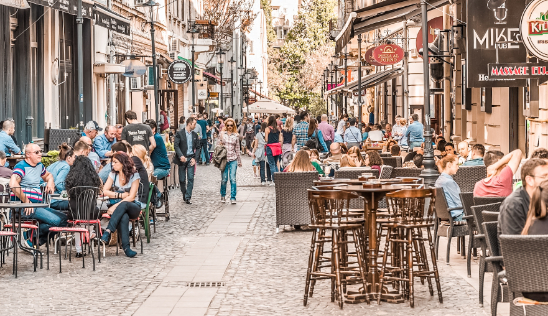
From Piata Unirii in the south, Calea Victoriei in the west, and Bulevardul I.C. Bratianu in the east, Old Town, an area more commonly known as Lipscani, thankfully escaped the bulldozers of Ceausescu and now offers a welcome respite from the monotony of Centrul Civic. The main street is Strada Lipscani itself, a lively street named after the Leipzig merchants who traded in the area in the 18th century. Bucharest’s oldest neighbourhood, an otherwise picturesque and pleasantly decaying maze of streets and crumbling houses, has been undergoing a painfully slow redevelopment for years, and while many parts of it remain hopelessly run-down, the sheer volume of restaurants, cafes, and bars in the area makes it the place to have fun in the city.
Arch of Triumph
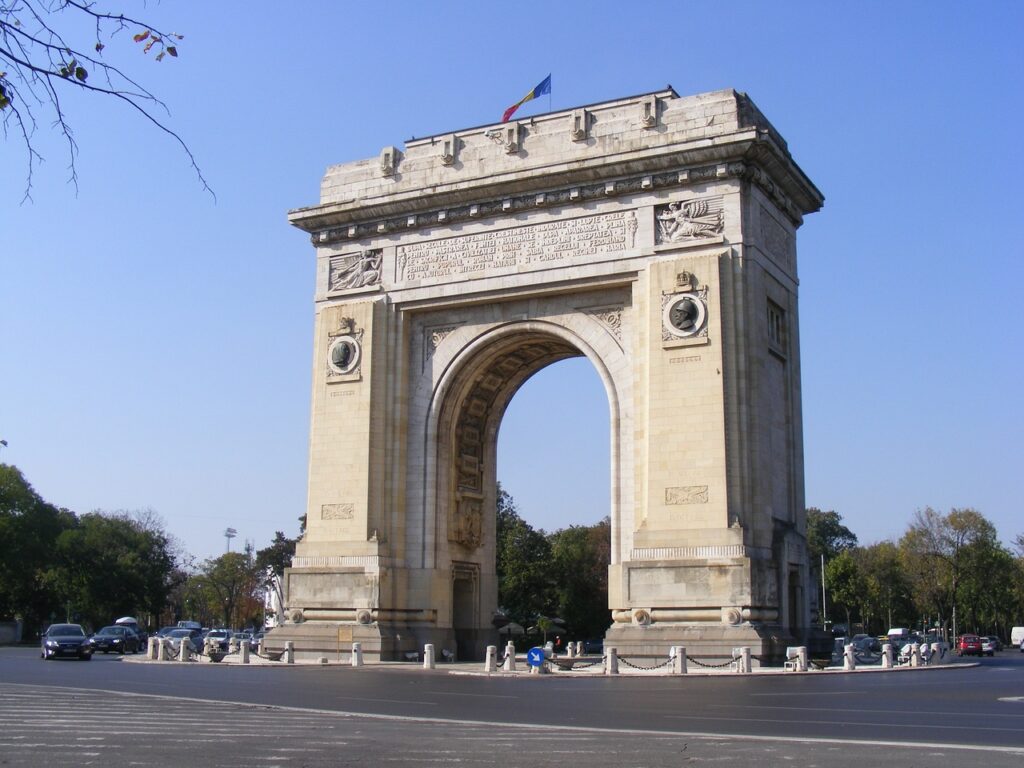
The Arc de Triumph is 27 metres high and is located on Kiseleff Street, in the northern part of Bucharest. After Romania gained independence in 1878, wooden beams were hastily constructed and erected soon afterwards so that victorious troops could pass underneath.
The arch was rebuilt in 1922 and later replaced in 1935 to honour Romanian soldiers who fought in World War I. Now, the structure is made of stone and adorned with statues of Romanian heroes. It is a popular tourist destination, as it is one of Bucharest’s most recognizable attractions.
Unirii Square
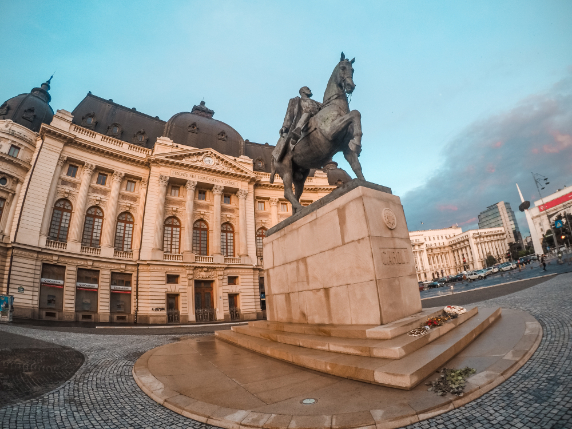
The city’s largest square, Unirii, is behind the large shopping malls and advertisements that flash brightly with neon lights as soon as darkness falls.
The Church of Stavropoleos
This beautifully restored 18th-century church (built 1724). Apart from its impressive architecture, it is known for the Byzantine music played by its choir. It has an excellent library with more than 8,000 books, including the largest collection of Byzantine music books in Romania. It also has an impressive collection of religious objects. Although extensively damaged by earthquakes over the years, it has been carefully restored, and the chandeliers and the dome of the church are particularly beautiful.
Calea Victoriei Avenue
Huge and busy avenues, with wide sidewalks, intersect there. You will see luxury hotels of well-known chains, very expensive boutiques, trendy cafes, countless casinos, and prestigious buildings, with the Military Academy being a typical example.
Village Museum (Muzeul Satului)
The most important attraction in Bucharest is the Muzeul Satului (Village Museum) on the shores of Lake Herastrau. The entrance is located on Soseaua Kiseleff Street, just above the Arc de Triomphe. Founded in 1936, it has a total of over three hundred houses, workshops, churches, windmills, and other structures from every region of the country, thus illustrating the extraordinary diversity of Romanian architecture.
Of greatest interest are the carved oak houses, as well as the gates with beams carved with animals and hunting scenes, Adam and Eve, the Tree of Life, and suns and moons. The souvenir shop there is the best place in town to buy folk art items such as textiles and costumes, ceramics, and wooden utensils.

Piata Revolutiei (Revolution Square)
Revolution Square, a large, irregularly shaped square cut in half by Calea Victoriei, was created in the 1930s to provide a protective field of fire around the Royal Palace in the event of a revolution. While Romania’s monarchy was overthrown by other means, the square fulfilled its destiny in 1989, when the Ceausescu couple were forced to flee by crowds besieging the Communist Party headquarters.
Herastrau Park
Designed in 1936, it is the largest park in Bucharest. It is suitable for casual walks for both tourists and locals. There are even several paths leading to numerous lakeside snack bars and restaurants, as well as a pier where you can rent rowing boats or take a mini-cruise on the lake. The residential area east of the park is one of the most exclusive neighbourhoods in Bucharest. This is where the communist elite once lived, isolated from the ruling masses.
Romanian Athenaeum
The Ateneul Roman (Romanian Athenaeum) is a magnificent neoclassical building built in 1888 by the French architect Albert Galleron. It claims the title of the best building in Bucharest. It is surrounded by six elegant columns, behind which, on the peristyle, are five circular mosaics, each depicting a Romanian ruler, including King Charles I. It was almost entirely financed by the citizens of Bucharest, as the original sponsors ran out of money, and it is one of the few remaining circular amphitheatres in Europe.
It hosts concerts of the George Enescu Philharmonic Orchestra, named after Romania’s beloved national composer. In Piata Enescu, the small, tidy park in front, there is a statue of Enescu, who first appeared at the Atheneum in 1898.

Carturesti Carusel Bookstore
It is an impressively large and beautiful bookstore in the heart of the capital. Located in an old bank, it has six levels and covers an area of over 1000m2, which is filled with books. It is incredibly beautiful inside with elegant decoration. Its intricate arches, spiral staircases, overflowing bookshelves, and columns have made this bookstore a monopoly even on Instagram.
You can find over 10,000 volumes of books to buy in their store. There are fiction sections, classics, poetry, self-help, gardening, biographies, and children’s books. It also has a multimedia area in the basement, a modern art gallery on the first floor, and a bistro at the top. It’s an innovative place for people to visit where they can read, socialize, be inspired, and connect.
Finally, the bookstore has an amazing selection of over 5,000 movies for sale, along with vinyl records and CDs. You can also find an area with stationery, travel luggage, toys, crafts from local artisans, chocolates, local wines, and Romanian souvenirs that you can buy to take home with you.

Gradina Cismigiu
In the middle of Bulevardul Regina Elisabeta, the magnificent Cismigiu Gardens were formed as a park on land bequeathed to the city in 1845. Originally, it belonged to a Turkish water inspector. The gardens include a serpentine lake in which small boats and bicycles glide, rented by couples seeking solitude among the swans and willows. Otherwise, the gardens are just a quiet space, with workers resting under the trees at lunchtime and retirees meeting for games of chess. At the northern end of the park, a Roman garden contains busts of some of Romania’s great literary figures, for children there is an attractive little playground by the lake.
Excursions to nearby areas
Within easy reach of the country’s capital, one can head to the Carpathian Mountains. The train ride is very beautiful, but you can also go in your car. You can take the train from the central station, Gara de Nord. Usually, travellers choose the famous castle of Bran, also called the castle of Count Dracula, the Peles castle in the town of Sinaia, and the beautiful medieval town of Brașov.
More options can be found in our Romania article
Best places to eat in Bucharest
Caru cu Bere Brewery
Considered one of the hot spots in the old town. You can’t be in Bucharest and not visit it. It is the favourite meeting point for both locals and foreign tourists. It has an amazing atmosphere, and there are many interesting details inside. There are wide varieties of beers, but also several choices of meats and appetizers, which are delicious and well-cooked.
Grand café Van Gogh
An elegantly designed restaurant, serving great food and drinks, known for its special weekend brunch, located in the heart of Bucharest! It offers perfectly cooked salads with goat cheese, hamburgers, and bacon. Many guests come to order good apple pie, French toast, and Pavlova. The shop also serves delicious varieties of wines, draught beers, and cider.
Zexe
This shop has a unique menu with traditional Romanian flavours. Although the restaurant’s tables are set with white tablecloths and good cutlery, it is still a casual restaurant for any occasion. Many choose to try varieties of meat, the beef sweetbread, the pizdulice (a unique piece of pork from the inside of the thigh), and the mitittei (a roasted meatball made from a special blend of meats and house spices). Some nights you might even catch live music.
The Artist Restaurant
This restaurant is housed in an old building with a beautiful layout and has a lovely garden. It is an excellent gourmet experience for the most demanding foodies. The food and presentation of this are excellent, as is the service and the menu with its wine selections. Prices are higher than most places in town, but are commensurate with the quality and experience you get.
When to go
Winter temperatures are often below 0 °C, sometimes even as low as -20 °C. For these reasons, avoid trips to the city at that time, as it is likely that much of what you want to do will be postponed. The only positive thing about the winter months is the more attractive prices for both airfare and accommodation. In summer, the average temperature is 23°C (the average for July and August), although temperatures often reach 35-40°C in the city centre in mid-summer. The good months to visit Bucharest are late spring and early autumn. Temperatures are mild and allow for all kinds of excursions.
Bucharest Travel Guide FAQ — Everything you need to know
Absolutely, and it’s one of Europe’s most underrated capitals. “The Little Paris of the East” has world-class museums, a stunning Belle Époque city center, one of the most extraordinary buildings on the planet (the Palace of Parliament), a buzzing Old Town nightlife scene, and some of the best value for money of any European capital.
~50 RON (~€10) adults. Guided tours only, no independent access. Hours: 9 am–5 pm (Mar–Oct) / 10 am–4 pm (Nov–Feb). Entrance on the northern side, Metro Izvor (M1/M3). Bring photo ID.
Take the airport express train from Henri Coandă Airport to Gara de Nord, around 5.50 RON, runs 24/7, 20–25 minutes. This is the best option. Alternatively, use Bolt or Uber (~€10–15).
Brașov + Bran Castle + Pelș Castle (2.5 hours, classic Transylvania circuit, allow a full day), Sinaia (1.5 hours — Pelș Castle and mountain scenery), Prahova Valley skiing/hiking. Book organized day trips at GetYourGuide Bucharest.
Romanian Leu (RON), not the euro. Use bank-branded ATMs (Banca Transilvania, BCR, Raiffeisen). Avoid Euronet ATMs, which charge high conversion fees. Cards are widely accepted in the city center and Old Town.
Europe’s largest thermal spa and wellness center, 10km north of the center. Thermal pools, waterslides, saunas, tropical gardens, and outdoor bars across multiple zones. Day ticket: ~€20–30 (varies by zone/day).