Some trips stay with you long after you’ve unpacked. Our road trip through Norway’s Arctic North was exactly that kind of journey, the kind that makes you question why you waited so long to go.
We loaded up our van, crossed the Arctic Circle, and spent several days driving through some of the most jaw-dropping scenery on the planet. From the vibrant city of Tromsø to the dramatic mountain passes of Narvik and all the way out to the otherworldly Lofoten Islands, every single stretch of road delivered something that stopped us in our tracks. Towering peaks dropping straight into glassy fjords. Tiny fishing villages clinging to rocky coastlines. Spring light that seemed to last forever.
Norway has a way of making you feel very small, and completely alive at the same time. If you’ve been dreaming about an Arctic road trip and wondering where to start, what to see, or where to stay, you’ll find everything you need right here. We’ve put together this guide day by day, exactly as we lived it, so you can plan your own version and make every mile count.
General Information
Travel Documents
No visa is required to visit Norway for EU citizens; your ID card or passport is all you need. Norway is not an EU member, but it is part of the Schengen Area, so travel within Europe remains seamless.
If you’re traveling from outside the EU, the requirements vary depending on your nationality. Citizens of many countries, including the US, Canada, Australia, and the UK, can enter Norway visa-free for up to 90 days within 180 days. However, travelers from other countries may need to apply for a Schengen visa in advance.
The easiest way to check exactly what you need based on your passport is through iVisa, where you can look up requirements by nationality and apply directly if needed. As always, double-check the latest entry requirements before you travel, as rules can change.
Currency
The official currency is the Norwegian Krone (NOK). Cards are accepted at hotels, restaurants, gas stations, and most roadside stops. We barely touched cash throughout the entire trip. That said, if you plan to explore more remote areas, it’s never a bad idea to have a small amount on hand just in case.
Electricity
Norway uses 230V, 50Hz, with Type C and F plugs, the standard European two-pin format. No adapter needed if you’re traveling from within Europe.
Telecommunications
Norway has excellent mobile coverage, even in many remote areas. The main providers are Telenor and Telia. If you’re traveling from an EU country, your existing plan should work without extra roaming charges, though it’s always worth confirming with your provider before departure. Coverage in the Lofoten Islands is generally good, though you may hit the occasional dead spot on mountain passes.
If you’re traveling from outside the EU or want a dedicated data plan without affecting your home contract, an eSIM is the most convenient option by far. No physical SIM card, no hunting for a store when you land; you set it up before you leave home and activate it the moment you arrive. We recommend Airalo, one of the most reliable eSIM providers available, with coverage in Norway and across Europe at competitive prices. Use the code STRATO0588 at checkout, and you’ll get €3 off your first purchase.
Language
The official language is Norwegian, but English is spoken everywhere and to a very high standard. You’ll have zero trouble communicating; from city centers to tiny fishing villages, people are friendly and happy to help.
Culture & Religion
Norway has a rich cultural heritage rooted in Viking history and Nordic tradition. The majority of Norwegians are nominally Lutheran, but the country is modern, secular, and known for its progressive values. Norwegians tend to be reserved at first but warm up quickly, and they have an almost spiritual relationship with nature, known locally as friluftsliv (outdoor life). Respect for the environment is deeply embedded in daily life.
Nature
Norway is, quite simply, one of the most naturally stunning countries on Earth. The landscape shifts constantly, from the snow-capped peaks around Tromsø and the dramatic fjords cutting through Narvik to the iconic mountain-and-sea scenery of the Lofoten Islands. In spring, you get the best of both worlds: lingering snow on the peaks and the first burst of greenery in the valleys. Wildlife is abundant, with sea eagles, reindeer, and seals making regular appearances. This is a place where nature doesn’t just exist in the background; it dominates everything.
Food & Drinks
Norwegian cuisine leans heavily on what the sea provides. Fresh fish, king crab, shrimp, and cod are staples, and you’ll find them done beautifully in local restaurants. Stockfish (dried cod) is a regional specialty in Lofoten with centuries of history behind it. Fair warning: eating out in Norway is expensive, even by European standards. Many travelers choose to stock up at supermarkets like REMA 1000 or Kiwi to keep costs manageable, especially on the road. Our group did a mix of both. Local restaurants for the experiences worth having, supermarkets for everything else.
Fun Facts
- Norway is one of the wealthiest countries in the world, thanks largely to its oil reserves, yet it remains strikingly grounded and eco-conscious.
- The country has more coastline than almost any other nation on Earth, stretching over 100,000 km, including all its fjords and islands.
- The Lofoten Islands sit entirely above the Arctic Circle, yet enjoy surprisingly mild temperatures thanks to the Gulf Stream.
- Norway consistently ranks as one of the happiest countries in the world, and after spending time there, you start to understand why.
- The midnight sun means that in summer, the sun never fully sets above the Arctic Circle. In spring, the days are already dramatically long.
- Norway has one of the highest concentrations of electric vehicles per capita in the world. You’ll notice EV charging stations everywhere, even in remote areas.
- The country has no land border with Denmark, yet the two are deeply connected historically and culturally through centuries of shared rule.
- Trolls are a big deal hεre. Folklore, souvenirs, and even road names reference them regularly. Look for “Trollvegen” and “Trollfjord” on the map.
Day 1: The Journey Begins
There’s something about a travel day that hits differently. The alarm went off early, earlier than any of us would normally tolerate, but nobody complained. When you know what’s waiting at the other end, getting out of bed feels easy.
We met up with the group at Athens International Airport, checked in, dropped off our bags, and made our way to the gate. The first flight took us to Oslo, roughly four hours in the air, and from there we had another four hours to kill before our connecting flight to Tromsø. Airport layovers aren’t exactly the highlight of any trip, but the excitement in the group kept the energy up. We grabbed food, wandered the terminal, and before long we were boarding again.
We landed in Tromsø right on time. No delays, no drama. We picked up our van from the airport parking lot, the vehicle that would be our companion for the road trip ahead, loaded everything in, and headed straight to our hotel for the night, the Saint Elizabeth Suites and Spa.
By the time we checked in, it was late. The next day happened to be a public holiday in Norway, which meant everything around us was shut down. No restaurants, no bars, nowhere to go. We did what any reasonable group of travelers would do. Οrdered pizza delivery, spread out in the common area of the hotel, and made an evening of it. Good food, good company, and a lot of laughing about the days ahead. Honestly, not a bad way to start a trip at all.
After a long day of flights and airports, we called it a night early. Tomorrow, the real adventure would begin.
Day 2: Exploring Tromsø
We woke up refreshed and ready to go. By 7:30 am, we were already up on the fifth floor of the hotel for breakfast, and what a breakfast it was! The spread was enormous: warm dishes, cold cuts, fresh bread, pastries, eggs cooked every way imaginable. Exactly what you need before a full day of exploring. We loaded up our plates, fueled up properly, and by 9:00 am the whole group had gathered down at reception, ready to hit the city.
The skies weren’t perfect- a bit overcast- but at least it wasn’t raining, and honestly, that soft Nordic light suits Tromsø well.
Our first stop was Prestvannet, a peaceful lake sitting right in the heart of the city, just a short drive from the hotel. We did a relaxed one-hour walk around its perimeter, through pine trees and quiet paths with the kind of stillness you don’t expect to find five minutes from a city center. Prestvannet sits at around 80 meters above sea level and is a beloved spot for locals year-round. In winter it freezes over completely, and in spring it becomes a favorite for morning walks and birdwatching. A calm, unhurried start to the day.
The original plan was to follow up with a ride on the Fjellheisen cable car, which climbs to 421 meters above sea level and delivers one of the most spectacular panoramic views in all of Norway: the entire city, the surrounding fjords, and the islands stretching out toward the horizon. Unfortunately, it was closed for maintenance work. Disappointing, but these things happen. We made a mental note: if you’re planning a trip to Tromsø, check the cable car’s operational status in advance, especially in shoulder seasons.
From Prestvannet we crossed over to the other side of the bridge to visit the Arctic Cathedral, or Ishavskatedralen as it’s known locally. Even from the outside, the building stops you in your tracks. Its dramatic triangular glass facade was designed to reflect the Northern Lights and the midnight sun, and it’s become one of the most iconic structures in the entire country. We walked around it, took our photos, and soaked in the view back across the water toward the city.
Back on the Tromsø side, we parked the van and continued the rest of the day on foot. Our first stop was the Tromsø Cathedral, the northernmost Protestant cathedral in the world, built entirely of wood in 1861. It’s a much more intimate building than the Arctic Cathedral, but its simplicity gives it a quiet dignity that we really appreciated.
From there, we walked over to the statue of Roald Amundsen, the legendary Norwegian explorer who was the first person to reach the South Pole in 1911. He stands there looking out toward the sea, appropriately stoic, as if he’s still scanning the horizon for the next expedition. Tromsø served as a base for many of his Arctic and Antarctic ventures, and the city is deeply proud of that legacy.
Just a short walk away, we stepped into the Polar Museum, and it was one of the highlights of the day. The museum tells the story of the polar explorers who set out from Tromsø into the unknown, with exhibits on Amundsen, seal hunting, and the brutal realities of life in the High Arctic. It’s well put together and genuinely fascinating, even if you don’t consider yourself a history person.
After the museum, we made our way to the Gateway to the Arctic monument for a few photos, a fitting symbol for a city that has long been the launching point for expeditions into the great frozen north, before heading into the city center for lunch.
Now, here’s where I have to be honest about a mistake that cost us a fine. After eating, I headed back to the van earlier than the rest of the group to go pick them up at our meeting point. I assumed the parking system worked the way it does in many places: you pay based on how long you’ve been there when you leave. It doesn’t work that way in Norway. You pay upfront for a set amount of time, and if you go over, you get a ticket. Which is exactly what happened.
Lesson learned. From that point on, I downloaded EasyPark, an app that lets you start and stop parking sessions directly from your phone, pay only for the time you actually use, and avoid exactly this kind of situation. If you’re driving in Norway, download it before you go, as it works in Tromsø and across most Norwegian cities, and it will save you both money and stress. Wherever there were parking meters, we paid those directly from the start as well.
We got back to the hotel around midday for some downtime. A rest, a nap, a bit of free time. After the long travel day before, nobody argued with an afternoon off.
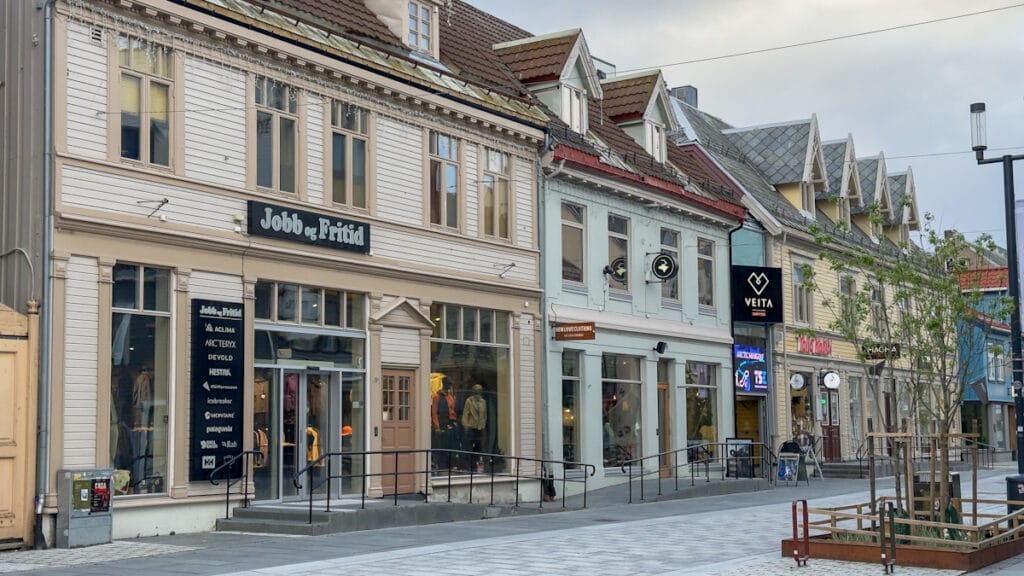
By late afternoon we were back out in the city for a second, more relaxed lap. Golden hour light in Tromsø in spring is something else entirely. We browsed souvenir shops, stopped for drinks, and eventually sat down for dinner. Two places stood out that evening: Egon, a reliable and popular restaurant right in the city center, great for a satisfying meal without a fight with the wallet, and Fiskekompaniet, a local favorite for fresh seafood with a more elevated feel. If you’re going to splurge once in Tromsø, this is the place to do it.
We wrapped up the evening with a walk back through the city streets, already talking about what the next day would bring.
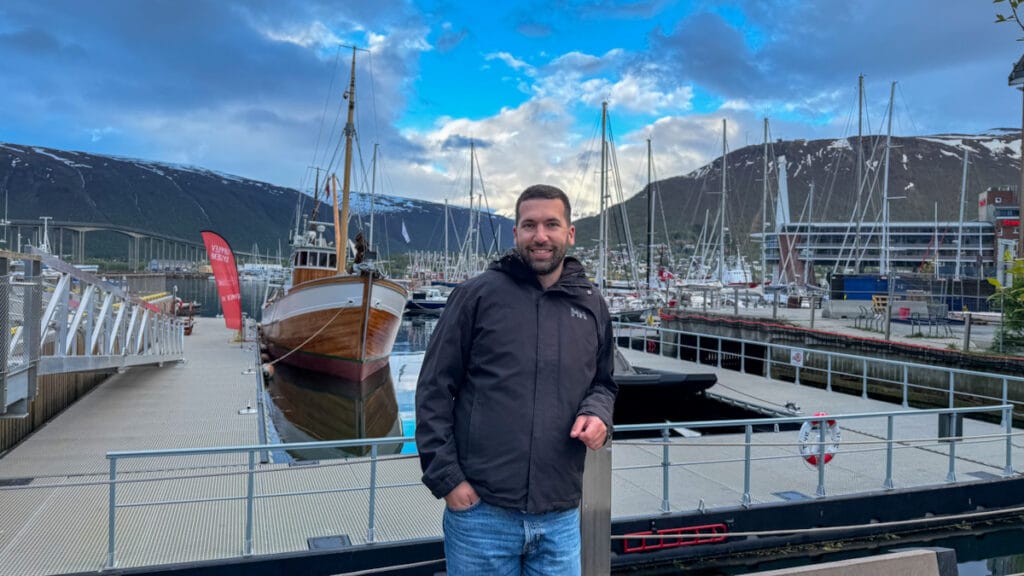
Day 3: Tromsø to Narvik — The Drive South
We sat down for breakfast one last time at Saint Elizabeth, making the most of that incredible spread before the road ahead. After we finished, we checked out, loaded everything into the van, and pulled out of Tromsø with the next chapter of the trip officially underway. Destination: Narvik.
The drive south through northern Norway is the kind of thing that makes you forget you’re supposed to be navigating. Snow-capped peaks, deep blue fjords appearing around every bend, and a road that feels like it was designed specifically to make you pull over every ten minutes. We tried to stay on schedule, but the scenery had other ideas.
One thing worth knowing before you drive in Norway: speed limits here are taken seriously. The roads through this part of the country are set at relatively low limits, often 80 km/h, sometimes less, and they are enforced hard. Speed cameras appear where you least expect them, fines are steep, and locals follow the rules without question. We did the same. It means the drive takes longer than you might expect on paper, but honestly, rushing through this landscape would be a crime of its own.
Our first stop was a Circle K in Setermoen for a bathroom break, snacks, coffee, the usual road trip ritual. Setermoen is a small military town nestled in the Bardu valley, and even a quick pit stop there gave us a glimpse of how dramatically the landscape had already shifted from coastal Tromsø to deep inland valleys.
Further along the route, we pulled over at a viewpoint above Gratangsbotn, a sheltered inlet where the fjord pushes deep into the mountains. We stepped out, stretched our legs, took in the stillness, and got some great shots. This is exactly the kind of stop that doesn’t appear on any itinerary but ends up being one of the moments you remember, just you, a quiet fjord, and mountains on every side. From there, we made our way into Narvik.
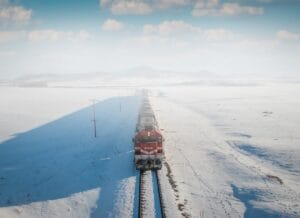
Narvik is a city with a story that goes far beyond its size. Built at the end of the 19th century as a year-round ice-free port, its entire existence was shaped by one thing: iron ore. The Ofoten Railway, known as one of the most scenic train journeys in Europe, was constructed between 1898 and 1902 specifically to transport ore from the Swedish mines at Kiruna across the mountains to the port here. Today, that same railway still runs, and catching it is high on the list for many visitors. The route through the mountains is spectacular, particularly in winter and spring.
Narvik also carries deep and heavy wartime history. In 1940, the city was the site of the Battles of Narvik, some of the fiercest fighting of the Norwegian campaign in World War II. Allied forces and Norwegian troops fought against German occupation for control of the port, and the city was largely destroyed in the process. The War Museum in the city center tells that story in full, and it’s worth a visit if history is your thing.
In winter, Narvik transforms into one of Norway’s best-kept skiing secrets. The Narvikfjellet ski resort sits right above the city and offers something genuinely rare: skiing with a direct view of the fjord below. It’s a combination you won’t find in many places on Earth, and it draws serious skiers from across Scandinavia.
We checked into the Scandic Narvik, dropped our bags, and had the rest of the day free to explore at our own pace. We wandered through the city center, browsed the two shopping malls, useful for picking up anything you need before heading further into the Lofoten Islands, and generally let the day unfold without a plan.
For dinner, we headed to Bella Italia Narvik, a well-reviewed Italian restaurant in the city that turned out to be a solid choice. Good food, warm atmosphere, and a welcome change of pace after a day on the road. And then came the moment that reminded all of us exactly where we were.
Back at the hotel, we headed up to the 16th floor for a drink together, and what we found up there was one of those simple, unplanned experiences that stays with you. The views stretched out over the fjord and the mountains in every direction, and the sun was still sitting high above the horizon. This was the midnight sun season. The sun never set. It just moved slowly across the sky, painting everything in a warm, golden light that felt completely surreal at that hour of the night. We sat there together, drinks in hand, watching the light do things that light isn’t supposed to do at midnight, and nobody was in any rush to leave.
Eventually, though, we called it a night. A big day was coming.
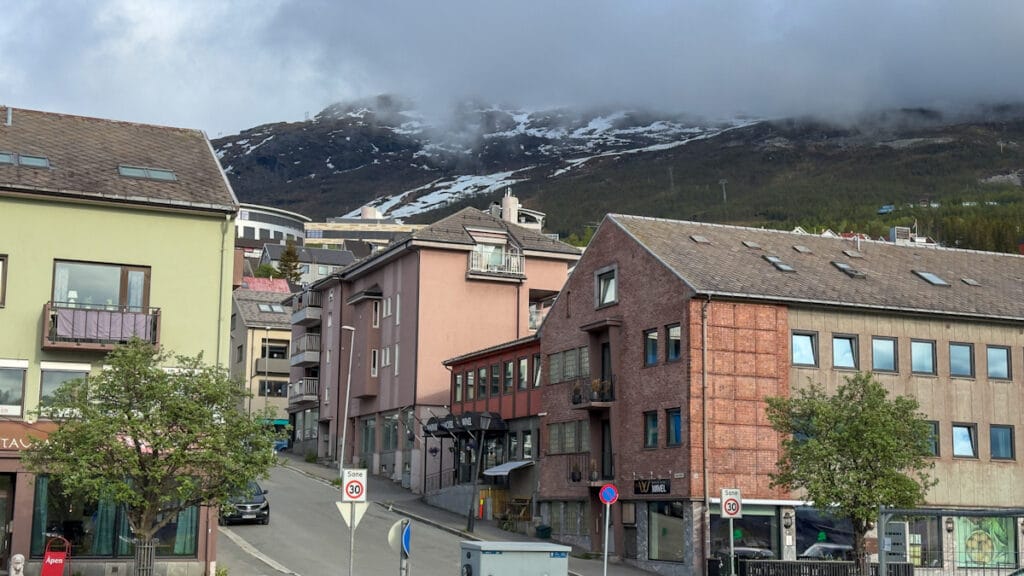
Day 4: Narvik to Lofoten
Breakfast, check out, load the van. By now we had the morning routine down to a science. By 9:00 am we were back on the road, but this time the destination was one we’d all been waiting for since the trip was first planned. The Lofoten Islands.
The drive from Narvik to Lofoten is one of those routes that makes you genuinely question how places this beautiful exist. You cross from the mainland onto a chain of islands via a series of bridges and tunnels, and with every kilometer the scenery gets more dramatic: jagged peaks shooting straight up from the sea, narrow roads clinging to coastlines, fishing villages appearing out of nowhere like something from a postcard.
Our first stop came early. The Tjeldsundbrua viewpoint sits at the crossing that marks the gateway into the Lofoten archipelago, and we pulled over to take it all in. The weather had other plans; rain rolled in just as we stepped out of the van, but we got our shots anyway, hoods up and laughing about it. A little rain in the Arctic North feels oddly appropriate.
Further along, we stopped at Lodingenbrygge for a much-needed refuel. Coffee, a bathroom break, and a chance to stretch out. What looks like a hotel from the outside also has a café that welcomes passing travelers, and it’s a solid pitstop on the way in. Warm, comfortable, and exactly what you need mid-drive.
From there, we made another stop at Raftsundbroen, a striking bridge that spans the narrow Raftsund strait with mountains rising sharply on both sides. We stepped out for photos and a few minutes of fresh air. Standing on that bridge with the water below and the peaks above, it hits you for the first time just how otherworldly this place really is. The Raftsund strait is also the gateway to Trollfjorden, one of the most dramatic and narrow fjords in all of Norway, a sheer-walled canyon barely wide enough for a ship to pass through. If you ever get the chance to see it by boat, take it without hesitation.
Before heading to our accommodation, we made a practical but important stop at the Extra supermarket in Kabelvåg. This was a deliberate choice because Kabelvåg has one of the better-stocked and more affordable supermarkets in the area, and the smaller shops inside Henningsvær, where we’d be based for the next four nights, come with the kind of prices that remind you how remote you are. We loaded up on supplies for the days ahead and got back on the road.
And then we arrived in Henningsvær. If you’ve seen photos of the Lofoten Islands and wondered which village looks like it was painted by hand, it’s probably Henningsvær. Draped across a cluster of small rocky islands connected by narrow bridges, with red and yellow fishermen’s cabins reflected in calm water and mountains rising in every direction, this place is often called the Venice of Lofoten, and once you see it, you understand why immediately. It’s one of those rare spots that looks exactly as good in real life as it does in photographs.
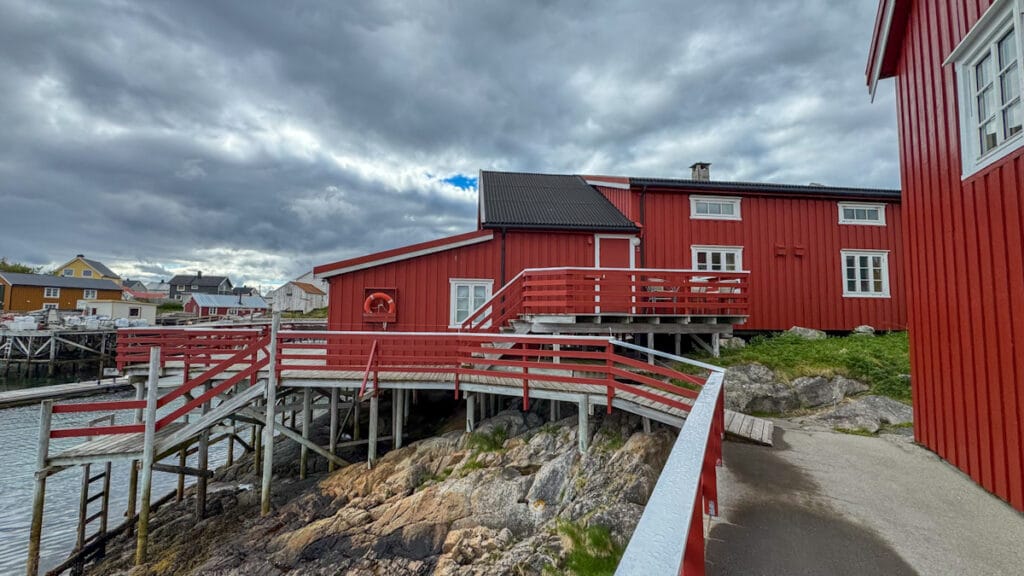
We checked into Henningsvær Rorbuer, and the accommodation itself was a highlight. Rorbu cabins are a piece of living Norwegian history, originally built in the early 20th century to house fishermen who came to Lofoten for the annual cod season; they’ve since been converted into some of the most characterful places you can stay in the entire country. Ours came with wooden walls, a small wood-burning stove, a little kitchen, and windows that looked straight out onto the water. After a string of hotel rooms, stepping into one of these felt like a completely different kind of travel. There’s a warmth and coziness to them; the Norwegians call it koselig, that you can’t manufacture.
We dropped our bags, had a proper look around our new home for the next few days, and then headed out on foot to explore the village together. Henningsvær is small enough to walk in its entirety in under an hour, but it rewards a slow pace. Narrow lanes between old wooden buildings, boats bobbing in the harbor, street art tucked into unexpected corners, and the kind of quiet that makes you slow your breathing down without even trying.
For dinner, we chose Klatrekafeen, a local favorite with a relaxed atmosphere and a menu that leans into what Lofoten does best. We all went for the cod, and it was exactly as good as it should be in a place like this. Lofoten cod has been one of Norway’s most prized exports for over a thousand years. The cold, clear Arctic waters and strong tidal currents produce fish of exceptional quality, and you taste the difference immediately. It was the right meal in the right place at the right time.
We walked back to the rorbuer as the midnight sun cast long golden shadows across the harbor. Four more days in this place. We were already happy about that.
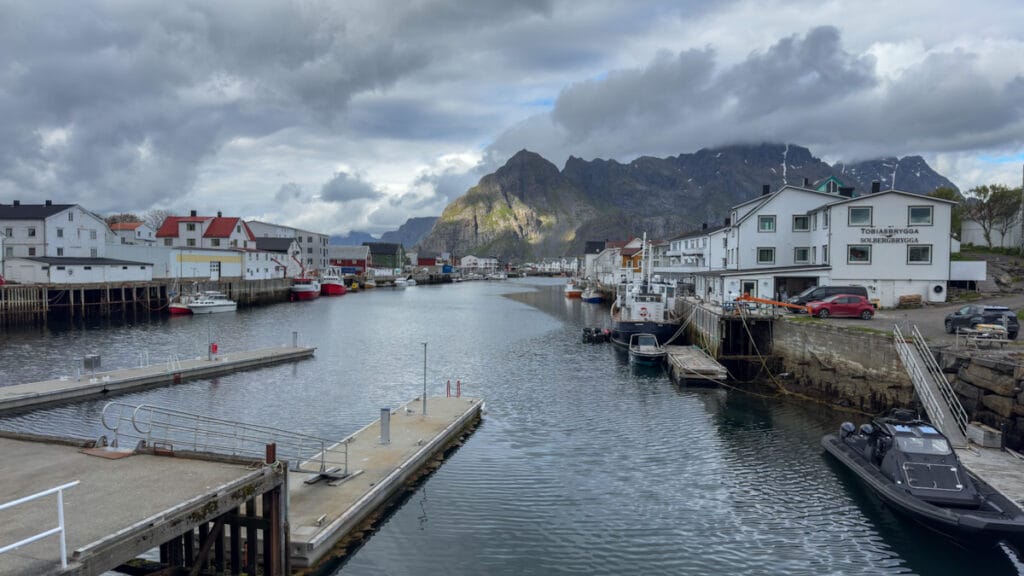
Day 5: Beaches, road closures, and 1,978 steps to the top
We were out the door by 8:00 am, which is saying something after the previous day’s drive. The goal was to get an early start on what looked like a full and ambitious day, and it turned out to be exactly that.
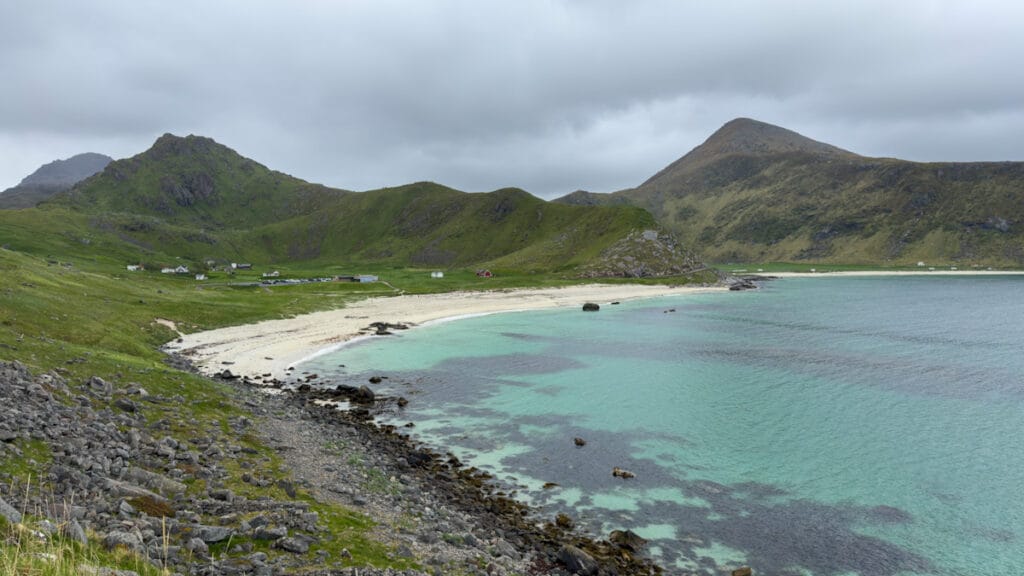
The first destination was Ramberg Beach, and it earns every bit of attention it gets. In a landscape defined by dark rock, deep fjords, and dramatic peaks, Ramberg comes as a genuine surprise, a long stretch of fine white sand backed by mountains, with water that shifts from pale green to turquoise depending on the light. It looks more like the Mediterranean than the Arctic, and on a calm morning it’s completely, almost impossibly beautiful. It’s the kind of place you walk onto and immediately stop talking.
Getting there, however, required some patience. The road was closed for construction works, and with no alternative route in sight, we had no choice but to sit and wait. Forty-five minutes. In a van. With the engine off. Not exactly the dramatic Arctic adventure we’d signed up for, but these things happen, and the mood in the group stayed good. Eventually the road opened, we rolled through, and the beach made us forget about it instantly.
From Ramberg, we continued along the coast and stopped at the Hamnøy viewpoint, one of the most photographed spots in all of Lofoten, and for very good reason. The cluster of red rorbu cabins sitting at the base of sheer mountain walls, reflected in still water, with more peaks layering into the distance behind them, is the image most people picture when they think of the Lofoten Islands. Standing there in person, you understand why photographers come from all over the world just for this shot.
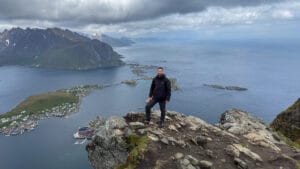
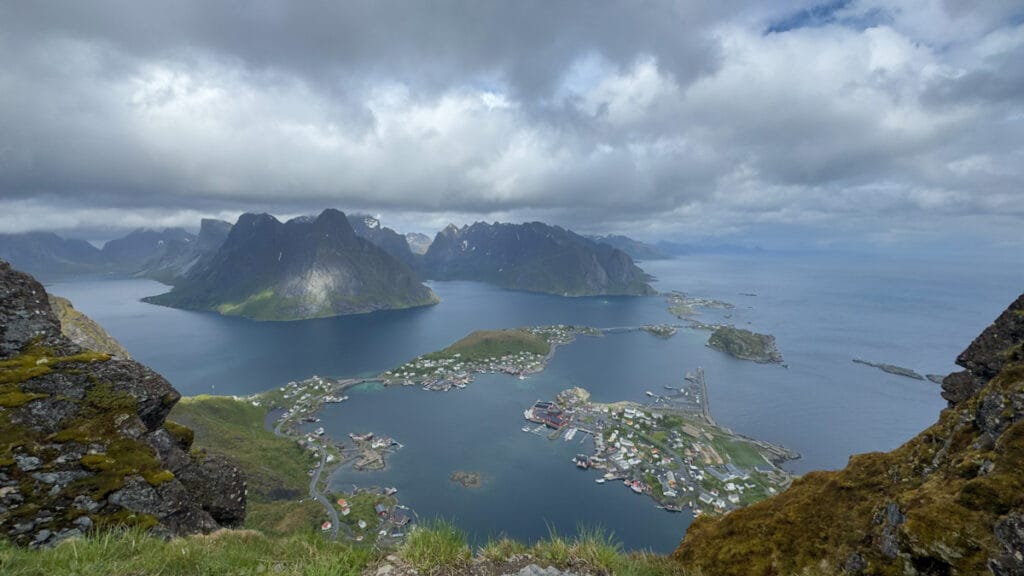
Then came the main event of the day: Reinebringen. Reine is widely considered one of the most beautiful villages in Norway, and the hike above it is one of the most rewarding in the entire country. The trail climbs 1,978 steps up the mountainside, carved directly into the rock face, and delivers a summit view that is genuinely hard to put into words. The entire Reinefjord unfolds below you, a maze of islands, water, and mountains stretching as far as you can see in every direction. On a clear day, it looks like a landscape from another world.
We started the ascent in the rain. A proper, cold, Norwegian mountain rain that had us reaching for our waterproofs within the first few minutes. The steps were slippery, the cloud was low, and more than once someone questioned the life choices that had led to this moment. But we kept going.
And then, somewhere near the top, the rain stopped. By the time we reached the summit, the clouds had pulled back enough to reveal the full panorama below us. We stood there catching our breath, partly from the climb, partly from the view, and just took it in. The whole group, together at the top, looking out over one of the most spectacular landscapes any of us had ever seen. Those are the moments that make a trip.
The descent was faster than the climb, as it always is. A few drizzles on the way down, but nobody cared anymore. The mission was complete.
After working up that kind of appetite, lunch was taken seriously. We headed to Tapperiet in Reine, a laid-back spot with good food and a locally-sourced menu. This was the moment several of us tried reindeer burger for the first time, rich, slightly gamey, and genuinely delicious. If you see it on a menu in Norway, order it. You won’t regret it.
After lunch, we made one more stop before heading back: the village of Å, pronounced exactly like the letter O, which never stops being amusing, sitting at the very southern tip of the Lofoten road, the last village before the islands give way to open ocean. Å is one of the best-preserved fishing villages in Norway, and it wears its history openly. Here you’ll find the Norwegian Fishing Village Museum, a beautifully maintained collection of 19th-century buildings that brings the old cod fishing era back to life.
Right alongside it sits the Lofoten Stockfish Museum, the only museum in the world dedicated entirely to stockfish, the wind-dried cod that has been produced here for over a thousand years and exported across Europe since the Viking Age. It sounds niche, but it’s genuinely fascinating. The history of Lofoten and the history of stockfish are essentially the same story.
We made our way back north toward Henningsvær, hit the road works again, a shorter wait this time, and arrived back at the rorbuer as the evening light settled over the harbor. Hot showers, full stomachs, tired legs. The best kind of exhausted.
Day 6: Vikings, white sand beaches, and a well-earned hot chocolate
With a slightly later start today, we rolled out at 9:30 am, which, after the previous day’s efforts, felt almost indulgent. The legs needed it.
First stop of the day was the Lofotr Viking Museum in Borg, and it’s one of those places that surprises you with how much it pulls you in. The museum is built around the site of the largest Viking longhouse ever discovered, a chieftain’s hall stretching over 83 meters, unearthed here in 1981 and reconstructed to full scale. Walking inside, you get an immediate sense of what life looked like for the Norse ruling class around 500-1000 AD. The presentations covered the full picture: how the chieftain and his household lived, the roles of the villagers and farmhands, the social hierarchy, the famous Viking raids, and the extensive trade networks that stretched from Scandinavia to Byzantium and beyond.
On the exhibits side, the collection is relatively modest, not because of any lack of effort, but simply because archaeological digs in this part of Norway don’t yield enormous quantities of preserved artifacts. What was found is displayed thoughtfully, and the context provided around each piece makes it meaningful. Don’t come expecting a packed treasure room, but do come expecting to leave genuinely more informed about who the Vikings actually were beyond the popular mythology.
The real fun came with the activities. We tried our hand at axe throwing and archery, both of which turned out to be considerably harder than they look and considerably more entertaining because of it. The competitive instincts came out immediately. There may have been a small but intense tournament happening by the end.
After the museum, we drove into Leknes for lunch, the largest town in the central Lofoten area and the practical hub of the islands. It’s not the most picturesque stop on the route, but it has everything you need: restaurants, shops, a proper supermarket, and a chance to feel like you’re back in civilization for an hour before heading back out into the wild.
From Leknes, we drove to Haukland Beach, another one of Lofoten’s spectacular white-sand beaches, and set off on a relaxed coastal walk through to Uttakleiv Beach and back. This is one of the more accessible hikes in the area, gentle enough for everyone in the group regardless of fitness level, and beautiful from start to finish. The path winds between the two beaches along the coastline, with the Norwegian Sea stretching out to the west, scattered sheep grazing on the hillsides with absolutely zero concern for the humans walking past them, and the kind of air that makes you feel genuinely healthier just for breathing it. Uttakleiv itself is a favorite among photographers. The combination of the white beach, the dramatic rock formations offshore, and the mountain backdrop makes for a striking scene at any time of day.
The water here, by the way, is part of the Norwegian Sea, the stretch of the North Atlantic that separates Norway from Iceland and Greenland. Cold, deep blue, and seemingly endless from the shore.
The perfect ending to the walk was waiting for us back at the parking area at Haukland, a small café right at the trailhead serving warm pastries and hot drinks with an unobstructed view out over the water. We settled in with hot chocolates and something sweet, still slightly windswept from the walk, and nobody was in a hurry to move. There’s a particular kind of contentment that comes from sitting somewhere like that after a bit of physical effort, warm drink, good company, Atlantic horizon in front of you.
We drove back to Henningsvær in the early evening, dropped everything off at the rorbuer, and kept the night free. After five days of early starts and full schedules, a quiet evening felt like exactly the right call. Rest, recharge, and get ready for the final stretch.
Day 7: Svolvær — A Summit, a sunlit harbor, and a running race we didn’t sign up for
Up early again. We left Henningsvær at around 8:30 am and made the short drive to Svolvær, the largest town in the Lofoten Islands and the closest thing the archipelago has to a capital. We parked up and headed straight for the trailhead, one more mountain to climb before the trip was done.
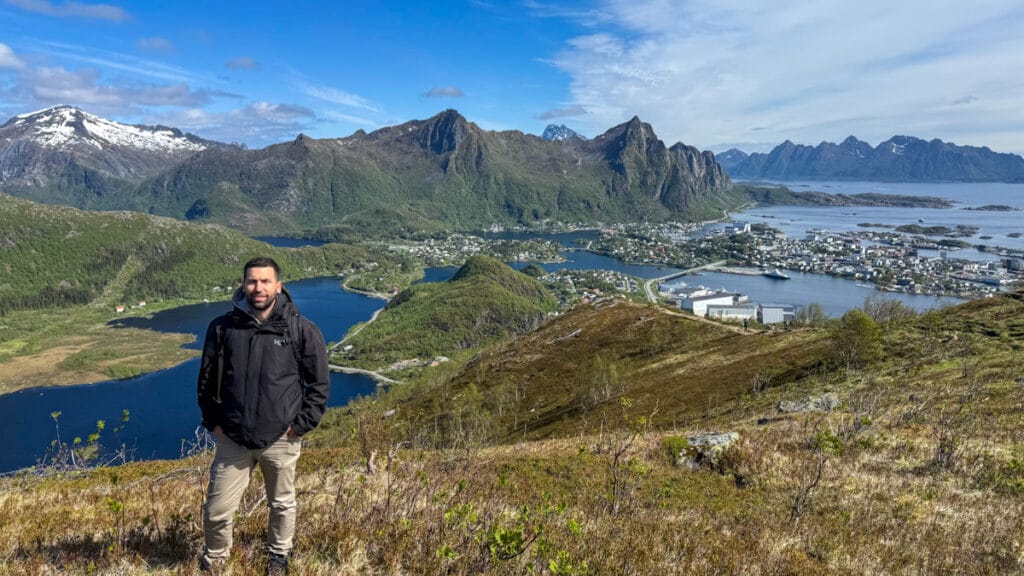
The hike was Tjeldbergtinden, and it delivered everything we’d come to expect from Lofoten’s trails, and then some. The route takes around three hours at a comfortable pace, and it earns its reputation. As you gain elevation, the landscape opens up progressively, until you reach a summit that offers a full 360-degree panorama: Svolvær and its harbor below, the jagged Lofoten peaks in every direction, the fjords cutting between the islands, and on a clear day, which this was, the open sea glinting in the distance. We stood up there in actual sunshine, which after a week of mixed weather felt like a gift, and took our time with it.
The trail itself deserves an honest mention: it was seriously muddy in places. Several days of prior rainfall had done their work on the path, and there were stretches where every step required a bit of thought. Waterproof boots are not optional on this one; they’re mandatory. Come prepared, and you’ll be fine. Come in regular sneakers, and you’ll regret it quickly.
After three-plus hours on the mountain, we were hungry. We came down into Svolvær and found our way to Bacalao, a restaurant right down on the harbor, and it turned out to be one of the best meals of the trip. The name gives it away: bacalao, salt cod prepared in the traditional Norwegian style, is the house specialty, and in a place like Lofoten that’s exactly what you should be ordering. Fresh, well-prepared, and served with a view of the water.
The harbor was buzzing. The sunshine had brought everyone out, and as it turned out, a running race was taking place through the town center that day, which meant extra crowds, a festival atmosphere, and the slightly chaotic energy of a small town hosting something bigger than usual. We watched a few runners go past, cheered appropriately, and enjoyed the fact that our only physical challenge for the rest of the day was a gentle walk.
After lunch, we took a relaxed stroll across the bridge to Svinøya, a small island just off the Svolvær waterfront, connected by a short pedestrian bridge, and one of the area’s oldest and most charming parts. The island has some of the most picturesque old rorbu cabins in Lofoten, a quiet harborside atmosphere, and great views back toward the town and the mountains behind it. It’s the kind of place you wander through slowly, with no particular agenda.
The rest of the afternoon was free. Souvenir shops, a browse through a clothing outlet, a coffee here and there. The easy, unscheduled hours at the end of a trip when you’re not trying to see everything anymore, just enjoying being somewhere.
Day 8: The long road back to Tromsø
Every road trip has that one day where the driving is the whole point, not because of what you see along the way, but because of where you need to be at the end of it. Day 8 was that day.
We were up and out of the rorbuer by 7:30 AM, bags loaded, keys handed in, and the van pointed north. The route back from Henningsvær to Tromsø is a long one, a full reverse of the journey that had brought us to the islands, and we knew going in that this would be a day spent mostly on the road. No major hikes, no new villages to explore.
Not that the drive is ever boring in this part of the world. The same landscapes that had stunned us on the way down were still there on the way back: the fjords, the bridges, the peaks, and there’s something quietly satisfying about retracing a route you now know well. You notice different things the second time around.
Our first stop came about two and a half hours in, at a Circle K in Sortland for fuel, coffee, snacks, and a stretch of the legs. Sortland is known locally as the “Blue City” for its distinctive painted buildings, and even a quick pit stop gives you a glimpse of a place that feels genuinely lived-in rather than built for tourists.
From there, we pushed on until we reached Bjerkvik Grill og Bar for lunch, a straightforward, honest roadside restaurant that did exactly what a good lunch stop should do. Hot food, reasonable prices, and enough of a break to reset before the final stretch. Bjerkvik itself sits at the head of the Herjangsfjord, and the views from the road around it are a reminder that even the unremarkable stops in Norway have something going for them scenically.
The last stop before Tromsø was a coffee break at Kaffeemøya in Bardufoss, a welcome pause after hours behind the wheel. Strong coffee, a moment to breathe, and then back on the road for the final push north.
We pulled into Tromsø and checked back into the Saint Elizabeth Suites and Spa, the same hotel where the trip had begun, which gave the whole journey a satisfying circular feeling. Same building, same rooms, completely different people inside them. A week in the Arctic North does something to you that’s hard to explain until you’ve done it.
The evening was free. Nobody had the energy for much, and nobody needed to pretend otherwise. We checked in, spread out, and let the exhaustion of a long driving day wash over us in the best possible way. Hot showers, quiet rooms, and the knowledge that we’d covered every kilometre of this trip exactly as it was meant to be covered, slowly, properly, and with our eyes open the whole way. One more day to go.
Day 9: Homeward bound
We sat down for breakfast one last time at Saint Elizabeth, and it was every bit as good as the first morning, the kind of spread that makes checkout feel genuinely inconvenient. We ate well, took our time, and then did what we’d done every morning for the past week: loaded the van and hit the road.
This time, though, it was different. The van was packed for the last time. The airport was only about ten minutes from the hotel, which made the farewell to Tromsø feel almost too quick. I dropped the group off at the entrance with the bags, and while everyone headed inside to check in, I took the van out one final time, filled up the tank, ran it through a car wash, and drove it back to the airport parking lot for the rental company to collect. A small but satisfying ritual, the proper closing of a chapter.
Inside the terminal, I grabbed my boarding pass from the self-check-in machine, fed my bag into the automated drop-off, and went to find the rest of the group, who had already cleared security and were making their way to the gate. We boarded the first flight to Oslo without any delays, and the leg north felt smooth and easy, the kind of flight where you’re still so full of the trip that you don’t even need anything to read.
Oslo gave us a two-hour layover, which we used in the usual way: food, coffee, a walk around the terminal, a last browse through the duty-free. Then, at the gate, came the announcement: a fifteen-minute delay on the Athens flight. After everything the trip had thrown at us roadworks, rain on mountain trails, a parking fine, and a van that needed its tank filled at 7 am, a fifteen-minute delay felt almost laughably mild. We barely flinched.
We boarded, we flew, and we landed in Athens right on schedule. Bags came out quickly, no one lost anything, and just like that, we were back.
The goodbye at the airport was the kind that takes longer than expected. We stood around longer than we needed to, recapping moments that had only happened days ago but already felt like stories we’d been telling for years. The Reinebringen climb in the rain. The midnight sun from the 16th floor in Narvik. The rorbuer and the wood-burning stoves. The reindeer burger. The cod in Henningsvær. The 360-degree view from the top of Tjeldbergtinden on a rare, perfect, sunny Lofoten morning.
Norway has a way of getting under your skin. The scale of it, the quiet of it, the way nature dominates everything without apology. You come back a little different, not dramatically, not in ways that are easy to articulate, but different nonetheless. More grateful for open space. More patient with slow roads. More convinced that the best trips are the ones that make you feel small in the best possible way.
Until the next one!
Norway (Tromsø & Lofoten) FAQ — Frequently Asked Questions
EU citizens can enter Norway with just their ID card or passport; no visa required. Citizens of many other countries, including the US, Canada, Australia, and the UK, can also visit visa-free for up to 90 days within 180 days. If you’re traveling from outside Europe, the easiest way to check your specific requirements is through iVisa, where you can look up what you need based on your nationality and apply directly if needed.
Yes, absolutely. There is no practical public transportation connecting Tromsø, Narvik, and the Lofoten Islands in the way this itinerary covers them. A rental car, or in our case, a van, is the only way to do a road trip like this on your own terms. We recommend comparing prices across providers at Discovercars.com before booking. Book early, especially for spring and summer travel, as vehicles go fast.
Yes, download it before you arrive. EasyPark is a parking app that lets you start and stop paid parking sessions directly from your phone, so you only pay for the time you actually use. Parking in Norwegian cities is paid and monitored strictly, and fines are expensive. We learned this the hard way in Tromsø. The app works across most Norwegian cities and towns, is straightforward to set up, and will save you both money and stress. Wherever parking meters were available, we used those directly, but EasyPark covered everything else.
It depends on what you’re after. We traveled in spring, which gave us dramatically long days, snow still sitting on the mountain peaks, and relatively manageable crowds compared to peak summer. The landscapes are at their most cinematic, green valleys starting to come alive, white summits, blue fjords. Summer (June–August) brings the midnight sun in full force, warmer temperatures, and the busiest tourist season. Winter (November–February) is Northern Lights season, with the best chances of seeing the aurora borealis, but shorter days and harsher conditions. Autumn sits somewhere in between. Great light, fewer crowds, and the first chances of catching the Northern Lights as the nights get darker again.
Above the Arctic Circle, the sun doesn’t set at all during the height of summer. In Tromsø, this runs roughly from late May to late July. In the Lofoten Islands, the midnight sun period is slightly shorter but equally striking. Sitting on the 16th floor of our hotel in Narvik watching the sun hover above the horizon at midnight is something none of us will forget quickly.
Not in spring or summer. The nights simply aren’t dark enough. To see the Northern Lights, you need to visit between late September and early April, with the peak window being November through February. Tromsø is one of the best places in the world to chase the aurora, with dedicated Northern Lights tours available throughout the winter season. If that’s your main goal, plan your trip accordingly.
Norway is expensive; there’s no way around it. Eating out regularly will hit your budget hard; a main course at a sit-down restaurant typically runs between €20 and €40 per person, and a beer can easily cost €10 or more. The most effective way to manage costs is to shop at supermarkets for breakfasts and some lunches. Chains like REMA 1000, Kiwi, and Extra are widely available and reasonably priced by Norwegian standards. Save restaurant meals for the experiences worth paying for, like fresh cod in Henningsvær or a reindeer burger in Reine.
Layers are everything in northern Norway, regardless of season. Even in spring and summer, temperatures can drop quickly, especially on mountain trails or near the water. The non-negotiables: a good waterproof jacket, waterproof hiking boots, thermal base layers, and a warm mid-layer. Rain is a constant possibility, and the weather can shift several times in a single day. Sunglasses are worth packing too. The spring and summer light at these latitudes is intense and long-lasting. And if you’re planning any hikes, trekking poles will earn their weight on the muddier trails.
Most of the hikes we did in Lofoten, including Reinebringen and Tjeldbergtinden, are well-marked and manageable without a guide, as long as you come properly equipped and check conditions before you head out. That said, mountain weather in Norway changes fast, and trails can be significantly muddier and more technical after rainfall. Always wear proper footwear, carry water and snacks, let someone know your plan, and check local trail conditions before you start. Apps like Wikiloc give highly accurate hiking routes and notifications from previous hikers.
Universally and excellently. From Tromsø to the smallest fishing village in Lofoten, you will have no trouble communicating in English at any point. Norwegian is the official language, but English fluency is effectively standard across the country.